
Contents
Last week, your IT department probably created an SAP system copy. For testing, for development, maybe for a training session. A standard process every SAP team knows and runs regularly.
What got copied along with it: every piece of personal data from the production system. Employee data, customer data, supplier contacts, transaction histories, bank details.
This standard process can lead to significant data protection and compliance risks if personal data remains unprotected in test systems.
The SAP System Copy: Standard Process With a Hidden GDPR Risk
System copies are indispensable in SAP landscape management. Developers need realistic data to test changes. QA teams need production-like scenarios to find bugs. And for migration preparation, test systems with realistic data volumes are the only sensible test basis.
The problem does not come from the process itself. It comes from what the copy contains, and from what fails to happen after the copy is made.
A full system copy contains everything. Every HR infotype with name, address, salary, and bank details. Every business partner with contact data and communication history. Every financial transaction with customer reference and payment details.
That data lands on a system that is typically less protected than production. Broader access rights. External consultants with read access. Sometimes developers with debug authorization on sensitive tables. No defined retention deadlines.
Why SAP Test Systems Carry the Same GDPR Obligations
What matters for the GDPR is that personal data is being processed – regardless of whether this happens in a production, development, or test system. The requirements for purpose limitation, data security, and access protection therefore apply in principle to all systems in which personal data is stored or processed.
SAP test systems should either run on anonymized or synthetic data or meet very high data protection standards. In practice, that means: extensive access controls, logging, defined retention deadlines, and limiting the data to what a given test actually requires.
A production-equivalent level of data protection is therefore rarely realistic for test systems. Anyone who wants to run test systems this way can end up restricting their usability so much that they quickly miss the point. A practical solution is consistent anonymization.
What Anonymization Has to Deliver
GDPR-compliant anonymization for SAP test systems is not a simple “overwrite the fields” exercise. The challenge also lies in referential integrity. Business partner BP-1234 shows up in dozens of tables: orders, invoices, payments, terms, contact persons. If anonymization turns BP-1234 into BP-ANON-5678, that has to happen consistently across every table. Otherwise, data integrity breaks and the test system becomes unusable.
That is exactly where simple approaches fail.
Subsetting
Data subsetting – that is, carrying over a deliberately selected slice of production data – reduces the data volume and, with it, often the number of personal data records. However, if the remaining data is still relatable to individuals, the data protection requirements continue to apply in principle.
Synthetic test data often reflects real business scenarios only to a limited degree. A synthetic supplier usually has no defensible order history, no pricing agreements, no seasonal patterns. That can be enough for narrowly scoped functional tests – for integration and performance tests, possibly not.
Manual masking quickly hits its limits in large SAP landscapes. In systems with 10,000, 50,000, or more tables, there is almost no way to ensure that sensitive content is replaced or obscured completely and consistently across every data set.
How to Anonymize 70 TB of SAP Data Consistently – DZ BANK Customer Example
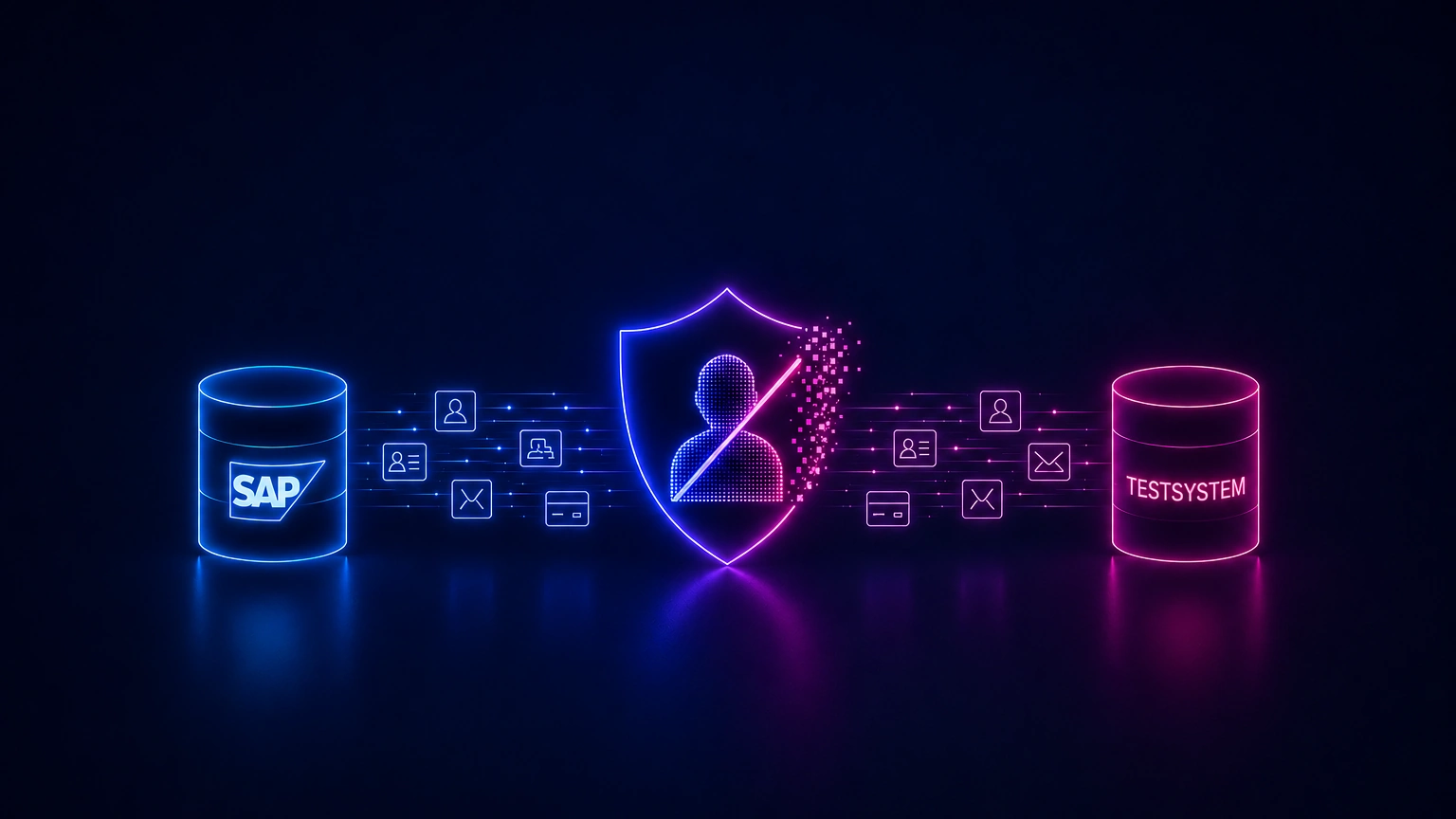
paricon’s Smart Data Protection (SDP) solution anonymizes SAP system copies completely and with referential integrity intact. That means: all personal data is replaced with consistent values that match up across every table. Relevant data relationships and the test system’s business usability stay intact, just without real personal data.

This is not a theoretical claim: at DZ BANK, an ERP system copy of around 70 TB was anonymized using Smart Data Protection. The result: a test system that is fully usable for realistic testing and GDPR-compliant at the same time.
Smart Data Protection runs SAP-native, without a data export, Clean Core-compliant. The solution detects personal data in standard tables and in customer-specific Z-tables, regardless of the type of SAP system or the SAP modules involved. Anonymization is repeatable, so every new system copy can run through the same process.
Read the DZ BANK Success Story →
The Timing Problem
Every system copy created without anonymization can add up to a potential GDPR violation. If your IT department creates system copies quarterly or monthly, that produces four or twelve new copies carrying personal data from production every year – and just as many new potential GDPR risks.
The risk is cumulative. Old test system copies that never get deleted contain personal data that may have long since been deleted from production. A person who exercised their right to erasure, whose data still lives on in three test system copies, has a legitimate grievance – and your company has a problem.
The answer is not to create fewer system copies – they are indispensable for testing and migrations. The answer is to anonymize every copy before it is used.
Standardized, automated, complete.
The First Step: Transparency Over Your Data
Many IT leaders underestimate the scope of personal data in their test systems because they only think of the obvious tables: HR master data, business partners, customer address data. But a system copy can also contain change documents with historical personal data, spool files with print output, application logs with user activity, and customer-specific tables that often store personal content without anyone documenting it.
A systematic GDPR scan of your test system shows which personal data is actually present. Not based on a guess, but through a complete analysis of every table and namespace. The result is the basis for the decision: which data needs to be anonymized? Which anonymization rules apply to which data types? How do you integrate anonymization into your existing system copy process?
With that knowledge, anonymization turns from a one-time project into a repeatable standard process. With every system copy. Automated. With no manual effort.